Introduction
If you have ever secured a website, configured a web server, or looked for the padlock icon in your web browser address bar, you have encountered the terms SSL (Secure Sockets Layer) and TLS (Transport Layer Security).
Both SSL and TLS are cryptographic protocols designed to encrypt network traffic, authenticate server identity, and ensure data integrity between web browsers and servers. However, while people frequently refer to "SSL certificates," the SSL protocol itself is obsolete and vulnerable. Modern web security relies entirely on TLS.
In this guide, we break down the historical evolution of SSL and TLS, explain key technical differences, explore why SSL was deprecated, and clarify why the term "SSL" remains in popular usage today.
🔒 Test Your Website's SSL/TLS Security
Verify your website's SSL/TLS certificate validity, expiration date, issuing authority, and supported protocol versions with our free lookup tool.
Run Free SSL Checker →What Is SSL (Secure Sockets Layer)?
SSL was created by Netscape in the mid-1990s to secure commercial transactions over the burgeoning World Wide Web. SSL version 1.0 was never publicly released due to severe security vulnerabilities. Netscape released SSL 2.0 in 1995, followed quickly by SSL 3.0 in 1996 to address flaws in version 2.0.
While SSL 3.0 laid the foundation for encrypted web traffic (HTTPS), it contained fundamental cryptographic weaknesses. In 2014, researchers discovered the POODLE attack (Padding Oracle On Downgraded Legacy Encryption), which allowed attackers to decrypt sensitive cookies from SSL 3.0 connections.
In 2015, the Internet Engineering Task Force (IETF) officially deprecated SSL 3.0 (RFC 7568), rendering all versions of SSL completely obsolete and unsafe for production use.
What Is TLS (Transport Layer Security)?
TLS is the modern, standardized successor to SSL. In 1999, the IETF introduced TLS version 1.0 (RFC 2246) as an upgraded replacement for SSL 3.0. Although TLS 1.0 was cryptographically similar to SSL 3.0, it introduced key improvements in message authentication and handshake algorithms.
Over the past two decades, TLS has evolved through four major versions:
- TLS 1.0 (1999): Improved upon SSL 3.0; officially deprecated in 2021 due to legacy cipher weaknesses.
- TLS 1.1 (2006): Added protection against CBC (Cipher Block Chaining) attacks; deprecated alongside TLS 1.0.
- TLS 1.2 (2008): Introduced SHA-256 hashing, authenticated encryption (AEAD), and support for modern cipher suites. Remains widely used today.
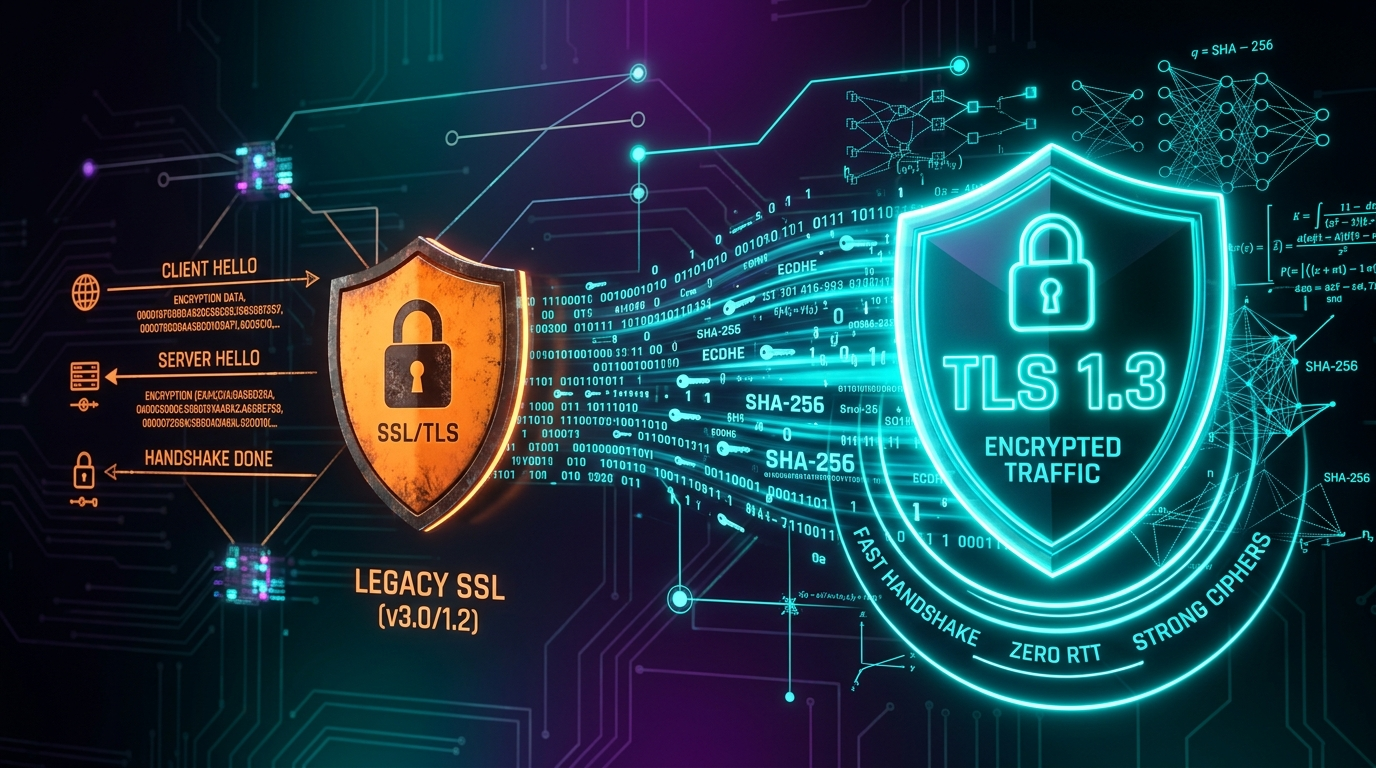
- TLS 1.3 (2018): The current state-of-the-art web encryption standard. It streamlined the cryptographic handshake from two round-trips to one (or 0-RTT for resumed connections), removed legacy insecure ciphers, and enforced Perfect Forward Secrecy (PFS) by default.
Key Differences Between SSL and TLS
Although SSL and TLS fulfill the same primary goal encrypting communication between client and server they differ significantly under the hood:
1. Cryptographic Handshake Speed
Before encrypted data can flow, a client and server perform a cryptographic handshake to authenticate each other and negotiate encryption keys.
Legacy SSL and older TLS versions required two full round-trips (2-RTT) of communication before sending encrypted payload data. TLS 1.3 optimizes this process to a single round-trip (1-RTT) and allows returning visitors to use 0-RTT (Zero Round-Trip Time) resumption, resulting in noticeably faster webpage load times.
2. Cipher Suite Security
SSL supported legacy cipher suites including RC4 stream ciphers, MD5 hashing, static RSA key exchanges, and 3DES encryption all of which have known vulnerabilities. Modern TLS (especially TLS 1.3) strips away outdated algorithms and only permits secure AEAD ciphers such as AES-GCM and ChaCha20-Poly1305 paired with Elliptic Curve Diffie-Hellman (ECDHE) key exchange.
3. Handshake Alert Messages
SSL relied on basic, unencrypted warning alerts during connection failures. TLS uses standardized HMAC (Hashed Message Authentication Code) signatures and specific alert codes, making connection troubleshooting cleaner and preventing tampering.
4. Perfect Forward Secrecy (PFS)
With older SSL configurations using static RSA keys, if an attacker recorded encrypted web traffic today and stole the server's private key years later, they could retroactively decrypt all past sessions. TLS 1.3 mandates ephemeral key exchange (PFS), ensuring that compromising a server key today cannot unlock past recorded communications.
🛡️ TLS Encryption in Virtual Private Networks
The cryptographic principles of TLS are not limited to web browsers. Modern VPN protocols (such as OpenVPN over TLS and WireGuard primitives) use TLS-level encryption to build secure, private network tunnels over untrusted networks.
Learn How VPN Tunnels Use Encryption →Why Do We Still Call Them "SSL Certificates"?
If SSL has been deprecated for years, why do Certificate Authorities (CAs), hosting providers, and security vendors still sell "SSL Certificates"?
The answer comes down to industry branding and consumer recognition. During the dot-com era of the late 1990s, the term "SSL Certificate" became deeply embedded in public vocabulary as the universal symbol for web security padlocks and HTTPS.
In reality, digital X.509 certificates are protocol-agnostic. A digital certificate does not dictate whether your server uses SSL or TLS. The certificate simply contains your domain name, public key, and digital signature from a trusted Certificate Authority. The actual protocol (TLS 1.2 or TLS 1.3) is determined by the configuration of your web server software (such as Nginx, Apache, or Caddy) and the client's browser capabilities.
📁 Encrypted Data in Transit & Storage
TLS encrypts your data while it travels across the internet ("in transit"). When backing up sensitive documents, pair TLS in transit with zero-knowledge client-side encryption ("at rest") to ensure no third party can read your files.
Explore Encrypted Storage Solutions →SSL vs TLS Protocol Version Summary
| Protocol Version | Release Year | Status | Security Level | Key Cryptographic Features |
|---|---|---|---|---|
| SSL 2.0 | 1995 | Deprecated (2011) | Insecure | Flawed MAC construction, vulnerable to man-in-the-middle attacks. |
| SSL 3.0 | 1996 | Deprecated (2015) | Insecure | Vulnerable to POODLE, BEAST, and RC4 cipher degradation. |
| TLS 1.0 | 1999 | Deprecated (2021) | Legacy / Unsafe | Upgraded MAC to HMAC; vulnerable to BEAST attacks. |
| TLS 1.1 | 2006 | Deprecated (2021) | Legacy / Unsafe | Added explicit IVs to protect against CBC attacks. |
| TLS 1.2 | 2008 | Active Standard | Secure | SHA-256 hashing, AEAD cipher suites (AES-GCM), mandatory TLS extensions. |
| TLS 1.3 | 2018 | Recommended Standard | Optimal | 1-RTT / 0-RTT handshakes, mandatory Perfect Forward Secrecy, banned weak ciphers. |
🧹 Secure Forms & Data Privacy
When submitting privacy deletion requests or entering sensitive data online, always ensure your connection uses active TLS encryption (HTTPS). Learn how to remove your data from data brokers safely.
Learn About Data Broker Removal →Frequently Asked Questions
Do I need to buy a new certificate to use TLS 1.3?
No. Digital certificates work with both TLS 1.2 and TLS 1.3. Upgrading to TLS 1.3 is handled entirely by updating your web server configuration (such as Nginx, Apache, or Cloudflare edge settings) and does not require reissuing or purchasing a new certificate.
Is SSL completely dead?
Yes. All major web browsers (Chrome, Firefox, Safari, Edge) have disabled support for SSL 2.0, SSL 3.0, TLS 1.0, and TLS 1.1. Attempting to connect to a server that only supports legacy SSL will result in a connection error.
How can I inspect a website's TLS certificate details?
You can use our free Certificate Decoder tool or SSL Checker to view certificate expiry dates, SANs, issuing CAs, and public key signatures.
Conclusion
While the industry continues to use "SSL" as a familiar shorthand for web security, SSL the protocol is obsolete history. Today's secure web relies entirely on TLS 1.2 and TLS 1.3 to provide high-speed, authenticated, and cryptographically sound encryption.
By enforcing TLS 1.3 on your web servers, disabling legacy protocols, and verifying certificate parameters regularly, you ensure your users benefit from maximum security and optimal page performance.