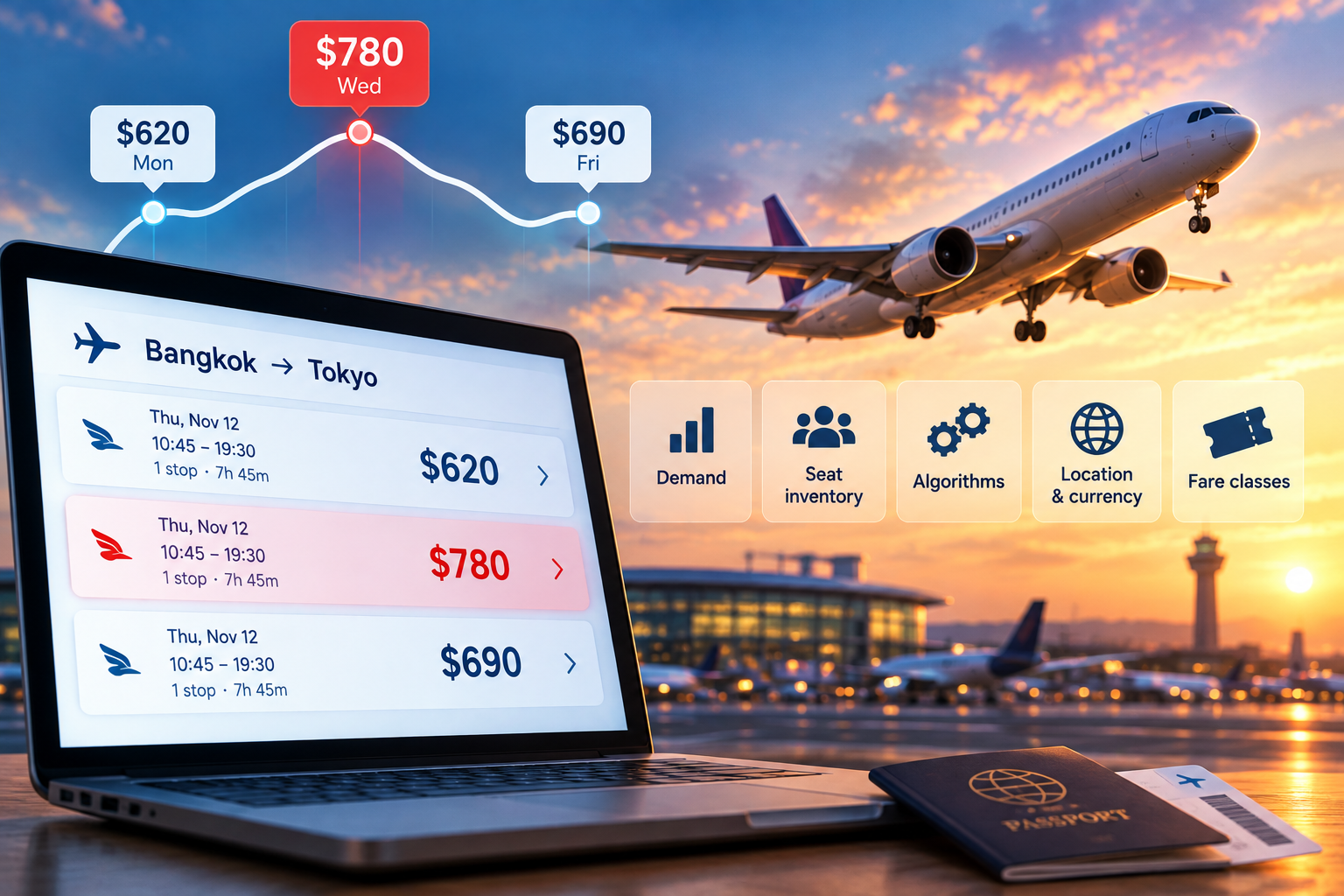
You find the perfect flight on Monday afternoon for $180. You decide to sleep on it. When you return to the airline's website on Wednesday, that exact same seat is suddenly $240. Frustrated, you wait. By Friday evening, the fare mysteriously drops back down to $195.
Did the airline detect your interest and play psychological tricks on you? Did an airline revenue manager manually intervene? Or is there a complex algorithmic system calculating every ticket price down to the second?
Flight prices are not fixed like products on a supermarket shelf. Airlines sell what economists call perishable inventory. Once an aircraft pushes back from the gate, any unsold seat has an economic value of precisely zero. To maximize total revenue on every scheduled departure, airlines utilize sophisticated Revenue Management Systems (RMS) that dynamically balance seat availability, consumer willingness to pay, historical demand curves, competitor pricing, and regional purchasing power.
In this guide, we demystify the mechanics of airline pricing: how fare classes and seat buckets work, why dynamic pricing causes rapid fluctuations, which common booking beliefs are complete myths, and how Point of Sale (POS) and currency conversion influence the final price you pay.
1. The Foundation: Fare Classes and Seat Buckets
When most travelers look at an airplane cabin, they see two or three sections: Economy, Premium Economy, and Business Class. But to an airline's computerized reservation system, the aircraft cabin is sliced into dozens of invisible inventory tiers called fare classes or fare buckets.
Within standard Economy class alone, an airline might operate 10 to 15 distinct booking codes, each designated by a single letter (such as Y, B, M, H, Q, V, W, S, T, L, K):
- Full-Fare Economy (Y, B): Fully refundable, free date changes, maximum mileage accrual, and last-seat availability. These can cost $500 or more on a short-haul flight.
- Mid-Tier Economy (M, H, Q): Standard leisure fares with partial change fees and standard baggage allowances.
- Deep-Discount Economy (V, T, L, K): Highly restricted promotional fares, non-refundable, no advance seat selection, and strict baggage limits. These might sell for as low as $40 to $80.
Crucially, every single passenger sitting in Economy occupies virtually identical seats, but the prices they paid depend on which specific bucket was open when their booking was completed.
| Booking Code | Fare Tier | Allocated Seats | Base Price | Ticket Flexibility |
|---|---|---|---|---|
K |
Super Promo | 10 seats | $79 | Non-refundable, no changes |
V |
Discount Economy | 15 seats | $120 | $50 change fee, no refund |
Q |
Standard Economy | 25 seats | $180 | Standard changes allowed |
M |
Flexible Economy | 20 seats | $240 | Free change, partial refund |
Y |
Full-Fare Economy | Remaining | $420 | 100% refundable, priority boarding |
When the 25 seats in bucket Q ($180) sell out, the reservation system does not "raise the price" in the conventional sense. Instead, bucket Q simply becomes unavailable, and the system automatically quotes the next tier: bucket M at $240.
2. Inside the Yield Management Algorithm
Modern airlines do not have rooms full of human pricing managers manually updating fares for thousands of daily departures. Instead, automated yield management and revenue optimization engines (developed by companies like Amadeus, Sabre, and PROS) continuously monitor inventory and forecast future demand.
These algorithms continuously analyze four primary data streams:
1. The Expected Booking Curve vs Actual Pace
Every route has a historical mathematical curve showing how seats typically sell over time. A holiday route to Orlando or Cancun fills up months in advance, whereas a business shuttle between New York and Chicago sees 70% of its bookings materialize in the final 10 days.
If a flight is scheduled for departure in 30 days and the historical model predicts 60 seats should be sold, but 85 seats have already been booked, the algorithm detects abnormal velocity. It immediately closes lower fare buckets, forcing all subsequent buyers into higher tiers.
2. Days Until Departure Milestones
Airlines operate on strict advance-purchase rules (e.g., 21-day, 14-day, 7-day, and 3-day deadlines). As a flight crosses these thresholds, cheaper fare basis codes expire automatically. Why? Because travelers booking less than a week before departure are predominantly corporate clients or individuals facing emergencies. Their price elasticity is low; they will pay whatever the airline charges.
3. Real-Time Competitor Scraping
Airline distribution systems ingest competitor schedule changes, capacity reductions, and fare adjustments via Global Distribution System (GDS) feeds and direct airline APIs. If Carrier A raises its lowest fare on a competitive route by $30, Carrier B's algorithmic engine detects the shift within minutes and often adjusts its own buckets accordingly.
4. Why Fares Drop Back Down (The Friday $195 Rebound)
Returning to our opening scenario: Why did the price drop from $240 on Wednesday to $195 on Friday?
- Expired Holds and Ghost Bookings: Corporate travel desks, online travel agencies (OTAs), and individual travelers often place 24- to 48-hour holds on tickets. If those reservations are not ticketed and paid for before the deadline, the seats automatically bounce back into active inventory.
- Slumping Demand Correction: If booking pace drops below projected targets after Wednesday's price hike, the algorithm recalibrates. To avoid flying with empty seats, the system releases a new batch of seats into an intermediate bucket (such as $195) to reignite sales velocity.
3. Debunking the Myth: Do Cookies & Incognito Mode Really Change Prices?
One of the most persistent internet urban legends claims that airline websites track your browser cookies, note that you have searched for the same route three times, and deliberately increase the price to create artificial urgency.
In reality, major airlines do not raise published fares based on individual tracking cookies.
Multiple academic research studies, regulatory audits, and consumer advocacy investigations (including thorough investigations by Consumer Reports and various consumer protection agencies) have repeatedly tested this hypothesis across hundreds of thousands of searches. The conclusions are unambiguous:
4. Point of Sale (POS), IP Geolocation & Currency Arbitrage
While clearing browser cookies won't magically halve your ticket price, there is a technical factor that genuinely changes flight prices: Point of Sale (POS) and IP Geolocation.
When you connect to an airline or travel aggregator, the website determines your location using your public IP address. Airlines do not sell tickets at a uniform price globally; they maintain different fare structures, promotional allocations, and local currency rules based on the consumer's geographic point of purchase.
How Point of Sale (POS) Pricing Operates
Point of Sale refers to the country where a financial transaction takes place. Airlines frequently release promotional fare buckets exclusively to the domestic market where a flight originates, or adjust prices based on regional purchasing power.
For example, booking a domestic flight within Peru, Colombia, Japan, or Southeast Asia from a foreign IP address often routes you to an international portal quoting fares in USD, complete with higher baseline fare classes. Browsing from a local IP address inside the destination country frequently unlocks local booking classes.
Currency Conversion and Airline Exchange Spreads
Airlines typically fix their internal currency conversion rates using periodic IATA clearing house exchange rates, rather than updating them tick-by-tick with the global forex market. When currencies experience volatility, discrepancies arise between what the airline charges in foreign currency and the true market value.
Furthermore, when booking on an international carrier's portal, selecting your home currency often triggers a Dynamic Currency Conversion (DCC) markup of 3% to 6% on top of the airfare.
💱 Check Real Exchange Rates Before Booking
Airlines and international travel portals often embed unfavorable currency conversion markups when displaying fares in foreign currencies. Always check the airline's original billing currency against live market rates to identify true price differences and avoid hidden fees.
Calculate Live Currency Exchange Rates →5. Does Using a VPN Actually Get You Cheaper Flights?
Because airlines vary pricing and currency options by region, many travelers wonder: Can I use a VPN to find cheaper airfares?
The realistic answer is: Yes, in specific scenarios, but it is not a universal discount hack.
Where a VPN Can Make a Measurable Difference:
- Domestic Flights in Foreign Countries: When traveling abroad, using a VPN connected to the destination country (e.g., Argentina, Thailand, or Mexico) allows you to access regional airline portals, regional payment options, and domestic fare buckets that are suppressed on international search engines.
- Regional Low-Cost Carriers: Budget airlines operating in regional markets frequently run local sales campaigns targeted strictly at residents of that geographic zone.
- Currency Arbitrage: By routing your connection through the carrier's home nation, you can evaluate the fare in the airline's native currency and compare it with the international quote using our exchange rate converter.
Where a VPN Will NOT Change the Price:
- Major Transatlantic or Transpacific Long-Haul Routes: Fares on routes like London to New York are heavily managed across global distribution networks. Whether you check from Paris, London, or New York, the underlying fare class availability for that specific city pair remains standardized.
- Credit Card Country Restrictions: Some regional airline sites require a credit card registered to a local billing address or a national tax ID to finalize transactions in local currency.
🔐 Travel Security & Location Privacy
Beyond checking regional point-of-sale offers, maintaining privacy while planning and booking travel is essential. Booking flights involves transmitting sensitive identity data, passport numbers, and payment details — often over insecure hotel or airport public Wi-Fi networks.
Using a trusted, zero-log VPN encrypts your connection, masks your IP from intrusive tracking scripts, and protects your transactions against interception on public networks.
Why Use a VPN for Travel & Privacy →If you test different regional portals, you can verify which geographic location and network websites detect by checking your public IP location with our IP Location Checker.
6. What Dictates Flight Prices: Reality vs Myths
To summarize how airline pricing functions in the real world, here is a direct comparison between algorithmic facts and common traveler misconceptions:
| Pricing Factor | Common Belief | How It Actually Works |
|---|---|---|
| Browser Cookies | Airlines raise prices because you searched multiple times. | Myth. Fares change due to seat bucket exhaustion, GDS cache refreshes, or booking curve milestones. |
| Incognito Mode | Private browsing guarantees cheaper airline tickets. | Myth. Private windows prevent local cookie tracking but do not change published airline fare buckets. |
| Fare Buckets | Economy tickets have a single unified price. | Fact. Economy is subdivided into 10–15 booking classes; when a cheaper tier sells out, the next price automatically activates. |
| Point of Sale (POS) | Prices are identical regardless of where you book from. | Fact. Purchasing in the flight's country of origin or in local currency can yield lower promotional classes. |
| Booking Day (Tuesday Myth) | Tuesday at 2:00 AM is always the cheapest time to buy. | Outdated. While airlines once loaded manual fares on Tuesday mornings, modern dynamic pricing adjusts 24/7 in real time. |
| Advance Purchase | Last-minute flights are heavily discounted to fill seats. | Myth. Last-minute flights are priced at maximum rates to capture high-budget corporate and urgent travelers. |
7. Actionable Strategies: How to Book at the Optimal Price
Understanding revenue management allows you to work with the system instead of guessing blindly. Here are proven, data-backed methods to secure the best fares:
Frequently Asked Questions
Do airlines track my cookies and raise prices if I search repeatedly?
No. Major airlines and Global Distribution Systems do not alter published tariffs based on individual user search history or tracking cookies. Price jumps occur when seats in a low fare bucket sell out, temporary holds expire, or aggregators refresh cached search records.
Why did my flight price drop after going up earlier this week?
Ticket prices drop when an airline's revenue management system notices seat sales falling behind historical projections, causing the algorithm to reopen cheaper fare classes. Additionally, unconfirmed reservations held by agencies frequently expire after 24 to 48 hours, returning cheaper seats back to public availability.
Can using a VPN get cheaper flights?
A VPN can help you access lower fares in specific situations, particularly for domestic flights within other countries or regional budget carriers that offer localized Point of Sale (POS) pricing. It rarely makes a significant difference for major long-haul international routes.
What are fare buckets and how do they work?
Fare buckets are inventory quotas within the same physical cabin (represented by letters like Y, B, M, Q, V, and K). Airlines assign varying quantities of seats to each letter at different price points. As cheaper buckets are exhausted, the booking engine moves automatically to the next tier.
Why are one-way international flights often more expensive than round-trip flights?
Traditional legacy airlines intentionally price international one-way tickets at full-fare, non-restricted rates (typically Y or B class) to extract maximum revenue from business travelers whose plans require open-ended itineraries, while discounting round-trip tickets that include a Saturday night stay.