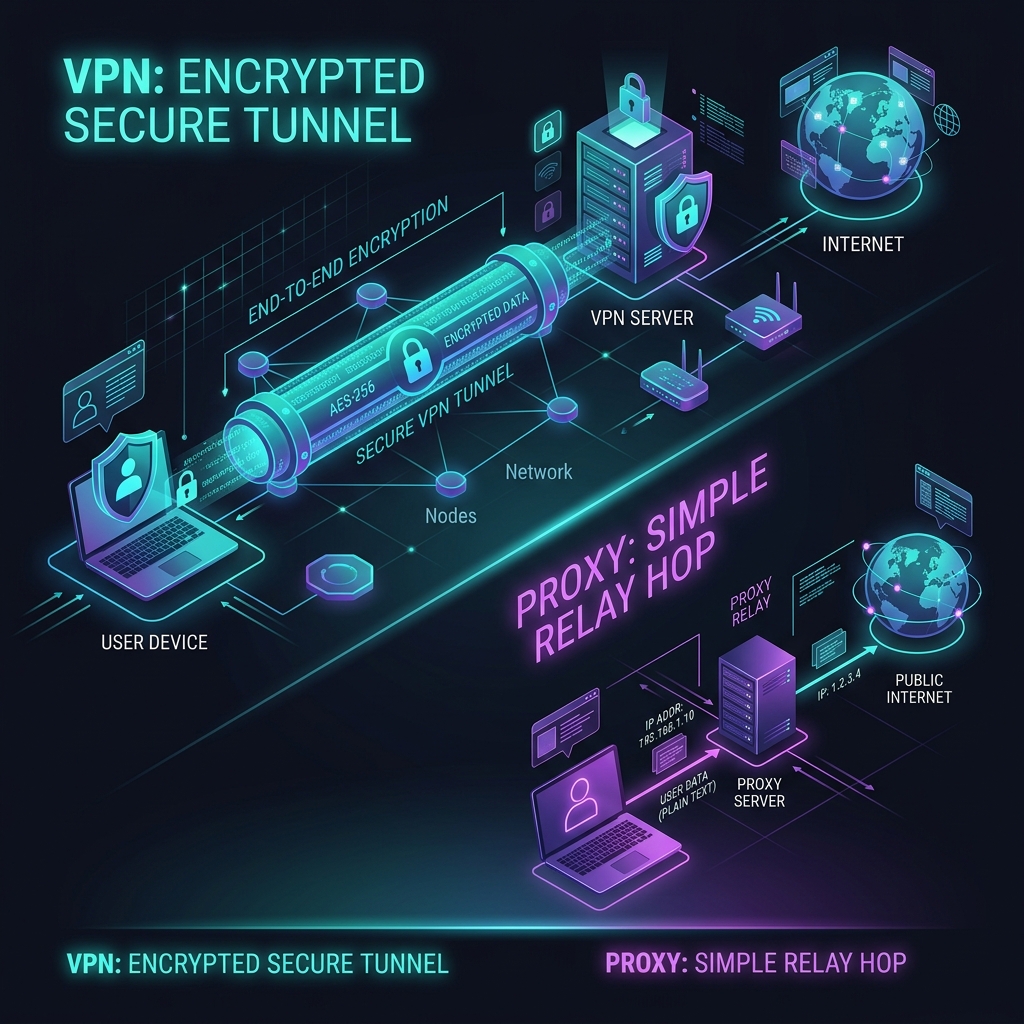
VPN vs Proxy: Quick Explanation
Both a VPN (Virtual Private Network) and a Proxy server work by re-routing your internet traffic through a remote server to hide your original IP address. However, they operate on completely different levels of security and scope.
- A Proxy server acts as a lightweight intermediary for a single application (like your web browser or torrent client). It changes your visible IP address for that app, but usually does not encrypt your data.
- A VPN operates at the system level. It routes and encrypts all network traffic coming from your device (operating system, apps, background services, DNS lookups) through a secure, encrypted tunnel.
In short: A proxy hides your IP address for a specific app, while a VPN hides your IP address AND encrypts all network traffic across your entire device.
🔎 Test Your Current Connection
Check what websites see right now—your visible IP address, ISP, country, and whether a VPN or proxy is detected:
Check My IP & Location →What Is a Proxy Server?
A Proxy server is an intermediary server that sits between your computer and the destination website. When you configure an application to use a proxy, your requests go to the proxy server first, which forwards the request to the target website on your behalf.
The target website sees the IP address of the proxy server instead of your real home or mobile IP address.
Common Types of Proxies
- HTTP Proxy: Designed exclusively for web traffic (HTTP/HTTPS). It interprets web pages and is commonly configured inside a web browser to bypass basic website blocks or content filters.
- SOCKS / SOCKS5 Proxy: A lower-level, protocol-agnostic proxy that handles any type of traffic (HTTP, FTP, P2P torrenting, gaming). SOCKS5 proxies are faster than VPNs because they do not overhead data with encryption, but they leave your connection unencrypted.
- Transparent Proxy: Often set up by school networks, employers, or ISPs without your intervention to monitor, filter, or cache web content.
What Is a VPN?
A VPN (Virtual Private Network) establishes an encrypted connection—often called a "tunnel"—between your device and a remote VPN server. Modern VPN protocols like WireGuard and OpenVPN use high-grade cryptographic standards (AES-256 or ChaCha20) to lock down all incoming and outgoing data.
Unlike a proxy, a VPN works at the operating system level. Once enabled, every single app on your system—browsers, messaging apps, email clients, cloud backups, and OS updates—transmits traffic through the encrypted VPN server.
Key Differences Between VPN and Proxy
| Feature | Proxy Server | VPN (Virtual Private Network) |
|---|---|---|
| Traffic Scope | App-level (only configured browsers or apps) | System-wide (all device network traffic) |
| Encryption | None (or HTTPS layer only) | Full end-to-end tunnel encryption (AES-256 / ChaCha20) |
| ISP Tracking Protection | ❌ No (ISP can see domain queries and unencrypted traffic) | ✅ Yes (ISP only sees encrypted data sent to VPN server) |
| Public Wi-Fi Security | ❌ Weak / None | ✅ Strong (protects against eavesdropping and Wi-Fi sniffing) |
| Leak Protection | Vulnerable to WebRTC, DNS, and IPv6 leaks | Includes Kill Switch, DNS leak & WebRTC protection |
| Speed Impact | Minimal overhead (fast for simple tasks) | Minor overhead due to encryption processing |
Encryption & Security: Why Proxies Can Be Risky
The primary flaw of most free or standard proxy servers is the lack of encryption. When you use an unencrypted proxy:
- Your Internet Service Provider (ISP) can still track which websites you connect to.
- Hackers on public Wi-Fi networks can still sniff your unencrypted data packets.
- The proxy owner can inspect, log, or even inject advertisements into your browsing sessions.
Furthermore, web applications running behind a proxy often leak real identity signals through browser APIs like WebRTC. For example, a web page can use WebRTC to expose your real local or public IP address even if an HTTP proxy is active in your browser. (Read our guide: Can Websites See My Real IP?).
🔐 Why a Secure VPN Outperforms a Proxy for Privacy
If your goal is true online privacy, a proxy is rarely enough. Free proxies often log user activity, sell browsing data, or lack encryption entirely.
A trustworthy zero-logs VPN encrypts all device traffic, prevents DNS and WebRTC leaks, and blocks ISP surveillance across all connected applications.
Learn What a VPN Really Does & Why You Need One →When Should You Use a Proxy?
Proxies remain useful for lightweight tasks where security is not a primary concern:
- Bypassing basic IP blocks: Quickly accessing a website blocked on a local firewall or workplace router.
- Web Scraping & Automated Bots: Developers rotating IP addresses to fetch public web data without triggering rate limits.
- App-Specific Rerouting: Configured inside a single app (like a P2P client) when you don't want to change the network path of your whole PC.
When Should You Use a VPN?
A VPN is essential for comprehensive security and digital privacy:
- Securing Public Wi-Fi: Protecting passwords and session cookies at coffee shops, airports, and hotels.
- Preventing ISP Tracking: Hiding your browsing habits, search history, and DNS lookups from your service provider.
- System-Wide IP Protection: Guaranteeing that no app accidentally leaks your real location.
- Bypassing Aggressive Restrictions & Censorship: Circumventing regional censorship or network throttling.
🛡️ Check If Your VPN Is Detected
Websites often use IP intelligence databases to detect whether an IP belongs to a proxy or datacenter VPN. Test your current connection:
Run VPN & Proxy Check →FAQ: VPN vs Proxy
Is a proxy safer than a VPN?
No. A proxy is significantly less safe than a VPN. Proxies usually do not encrypt your traffic and only redirect specific applications, leaving the rest of your system exposed.
Does a proxy hide my IP address completely?
A proxy masks your IP address for the specific application configured to use it. However, browser technologies like WebRTC or Java applets can still leak your real IP unless protected by system-level VPN routing.
Can I use a VPN and a proxy together?
Technically yes, but it is rarely necessary. Running a proxy inside a VPN connection adds extra latency and complexity without providing meaningful extra security over a properly configured VPN.
Are free proxies safe to use?
Free proxies are notoriously insecure. Operating proxy servers costs money; free proxy providers frequently monetize their services by capturing passwords, injecting ads, or selling browsing logs to advertisers.
Final Summary
While both tools hide your IP address, a proxy is a simple app-specific relay suitable for casual web browsing, while a VPN is a robust, encrypted security solution designed to protect your entire digital identity.
If you are serious about protecting your personal data, online privacy, and internet security, a reputable zero-logs VPN is by far the superior choice.
🛡️ Why Use a VPN? → 🌍 Check IP Location → 🔍 VPN & Proxy Check →