VPN Detection API: How to Detect VPN, Proxy and Datacenter IPs

A developer-friendly guide to detecting VPNs, proxies, Tor nodes, and datacenter traffic

VPN Detection API

What Is a VPN Detection API?

A VPN detection API helps developers identify whether an IP address belongs to a VPN provider, proxy service, Tor exit node, datacenter, or regular residential ISP.

Instead of manually maintaining IP blocklists, you send an IP address to an API and receive structured intelligence about the connection.

This is useful for fraud prevention, abuse control, signup protection, analytics quality, and risk-based access decisions.

VPN detection should not be treated as an automatic ban signal. It is best used as one layer in a broader risk scoring system.

Why Detect VPN, Proxy and Datacenter IPs?

VPNs are legitimate privacy tools, but they are also used in many abuse patterns. For developers and security teams, identifying connection type gives useful context before allowing sensitive actions.

Common use cases include:

  • Reducing fake account creation
  • Detecting suspicious login attempts
  • Preventing payment fraud
  • Blocking abusive automation
  • Improving geo-based analytics
  • Protecting APIs against scraping
  • Adding risk signals to authentication flows

How VPN Detection Works

A VPN detection API usually combines multiple IP intelligence signals instead of relying on one single indicator.

These signals may include:

  • Known VPN provider ranges
  • ASN and ISP ownership
  • Datacenter classification
  • Proxy and tunneling indicators
  • Tor exit node lists
  • Hosting provider networks
  • Historical abuse patterns
  • Reverse DNS and infrastructure clues

The goal is not only to answer β€œis this a VPN?” but to understand the broader connection context.

πŸ›‘οΈ Try the Free VPN Check Tool

Want a quick preview? Check whether your current IP is detected as a VPN connection:

Run VPN Check β†’

VPN Detection vs Proxy Detection vs Datacenter Detection

These signals are related, but they are not the same.

Signal Meaning
VPN The IP appears to belong to a VPN provider or tunneling service
Proxy The IP may route traffic for another user or application
Tor The IP is associated with the Tor anonymity network
Datacenter The IP belongs to hosting, cloud, or server infrastructure rather than a residential ISP

A datacenter IP is not always malicious. But in many consumer-facing workflows, datacenter traffic behaves differently from normal residential traffic.

Related guide: How to Identify Datacenter IPs.

What a VPN Detection API Should Return

A useful VPN detection API should provide more than a single boolean value.

For real-world decision-making, developers usually need:

  • IP address
  • Country and region
  • ASN
  • ISP or organization
  • VPN flag
  • Proxy flag
  • Tor flag
  • Datacenter classification
  • Risk or threat indicators

Example JSON Response

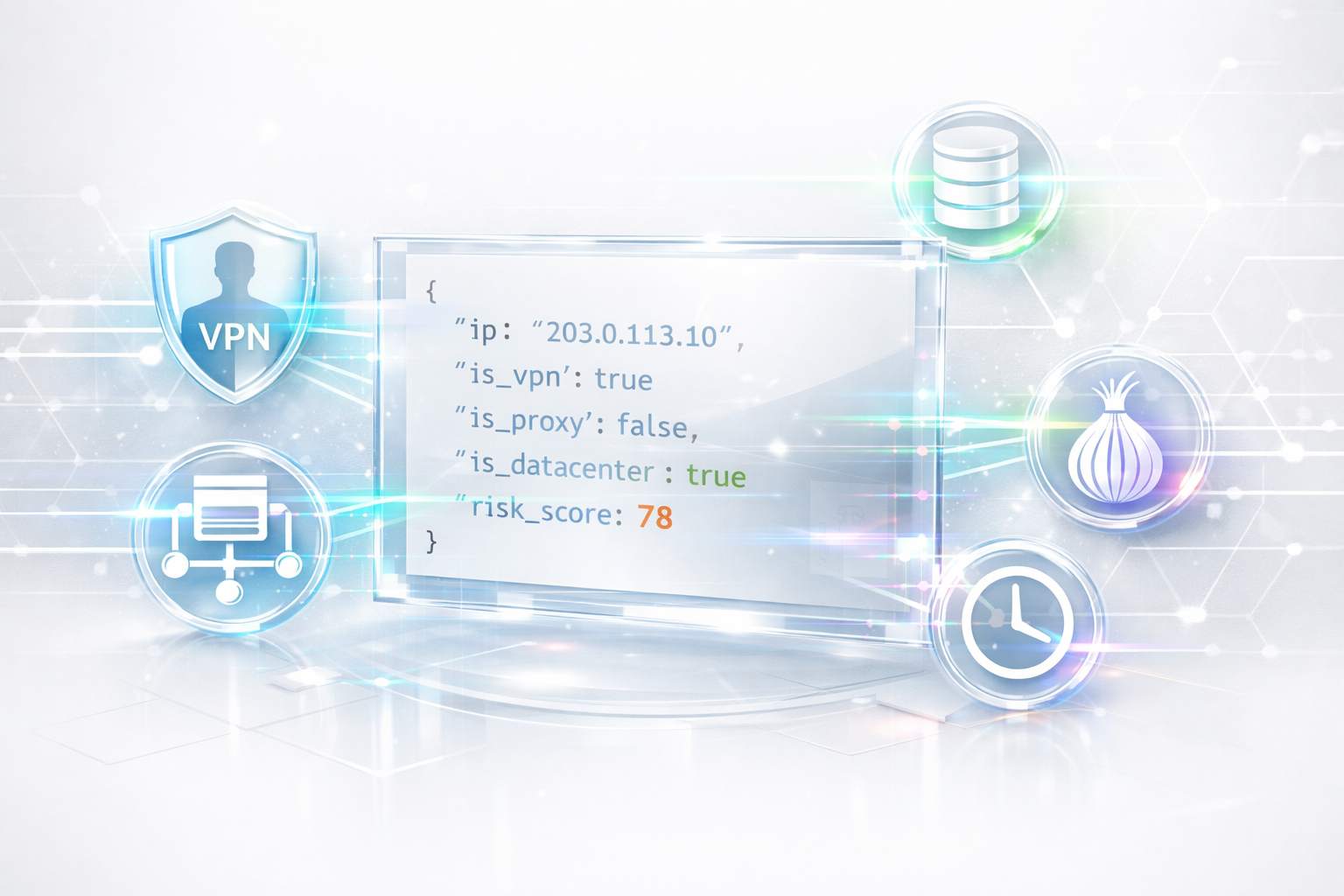
A typical IP intelligence response may look like this:

{
  "ip": "203.0.113.10",
  "country": "United States",
  "asn": 12345,
  "isp": "Example Hosting Provider",
  "is_vpn": true,
  "is_proxy": false,
  "is_tor": false,
  "is_datacenter": true,
  "risk_score": 78
}

This gives your application enough context to decide whether to allow, challenge, throttle, or block the request.

How to Integrate VPN Detection Into an Application

The simplest workflow is:

  1. Receive a request from a user
  2. Extract the client IP address
  3. Query the VPN detection API
  4. Read the returned IP intelligence signals
  5. Apply your business logic

Example use cases:

  • Allow normal residential traffic
  • Challenge VPN users with CAPTCHA
  • Block Tor for sensitive endpoints
  • Rate-limit datacenter traffic
  • Require stronger verification for risky IPs

Example cURL Request

With a simple JSON API, integration should be quick and predictable.

curl -H "X-API-Key: YOUR_API_KEY" https://myip.casa/api/pro/details

πŸ“˜ Developer-Friendly IP Intelligence API

Use the myip.casa API to detect VPNs, proxies, Tor, datacenter IPs, ASN data, ISP information, and risk signals.

View API Documentation β†’ Get API Key β†’

Where to Use VPN Detection

Signup Protection

If many accounts are created from VPN, proxy, or datacenter IPs, you may want to apply additional verification.

Login Risk Scoring

A login from a new country, datacenter IP, or VPN provider can be treated as a higher-risk event.

Payment Fraud Prevention

VPN and proxy usage can be combined with card country, billing address, and device fingerprinting to detect suspicious transactions.

API Abuse Mitigation

Datacenter and proxy traffic often appears in scraping, automation, and rate-limit bypass attempts.

Content and Licensing Controls

Streaming, media, and region-restricted services often use VPN detection to enforce licensing rules.

Best Practices for Developers

VPN detection works best when used carefully.

  • Do not automatically block every VPN user
  • Use VPN status as a risk signal
  • Combine with account history and behavior
  • Cache results to improve performance
  • Refresh cached IP intelligence periodically
  • Use stronger checks only on sensitive actions

For example, a VPN user reading public content may not need to be blocked. But the same VPN user creating hundreds of accounts may require additional controls.

Why Static Blocklists Are Not Enough

VPN and proxy infrastructure changes constantly. Providers rotate IPs, move servers, lease new ranges, and use multiple hosting networks.

Static blocklists quickly become outdated.

An API-based approach is more flexible because it can combine updated IP intelligence with live classification signals.

Related Developer Guide

If you want a practical implementation example, read:

FAQ

What is a VPN detection API?

A VPN detection API checks whether an IP address is associated with VPN infrastructure, proxy networks, Tor nodes, datacenter hosting, or residential ISPs.

Can VPN detection be 100% accurate?

No IP classification system is perfect. VPN detection is most useful when combined with other risk signals such as behavior, account history, and request patterns.

Can residential VPNs be detected?

Residential VPNs are harder to detect than datacenter VPNs, but they may still be identified through abuse patterns, proxy network signals, or reputation data.

Should I block all VPN users?

Usually no. Many legitimate users rely on VPNs for privacy. A better approach is to use VPN detection as part of risk scoring and apply stronger checks only when needed.

What is the difference between VPN and datacenter detection?

VPN detection identifies tunneling or privacy services. Datacenter detection identifies IPs that belong to hosting or cloud infrastructure. Many VPNs use datacenter IPs, but not all datacenter IPs are VPNs.

Final Thoughts

A VPN detection API helps developers understand the network behind each request. It provides context that can improve fraud prevention, abuse control, analytics quality, and security decisions.

The best systems do not rely on VPN detection alone. They combine IP intelligence with behavior, account context, and business rules.

If you need developer-friendly VPN, proxy, Tor, datacenter, ASN, and ISP intelligence, start with the API documentation and test the free key flow.

πŸ“˜ API Documentation β†’ πŸš€ Get API Key β†’ πŸ›‘οΈ Try VPN Check β†’