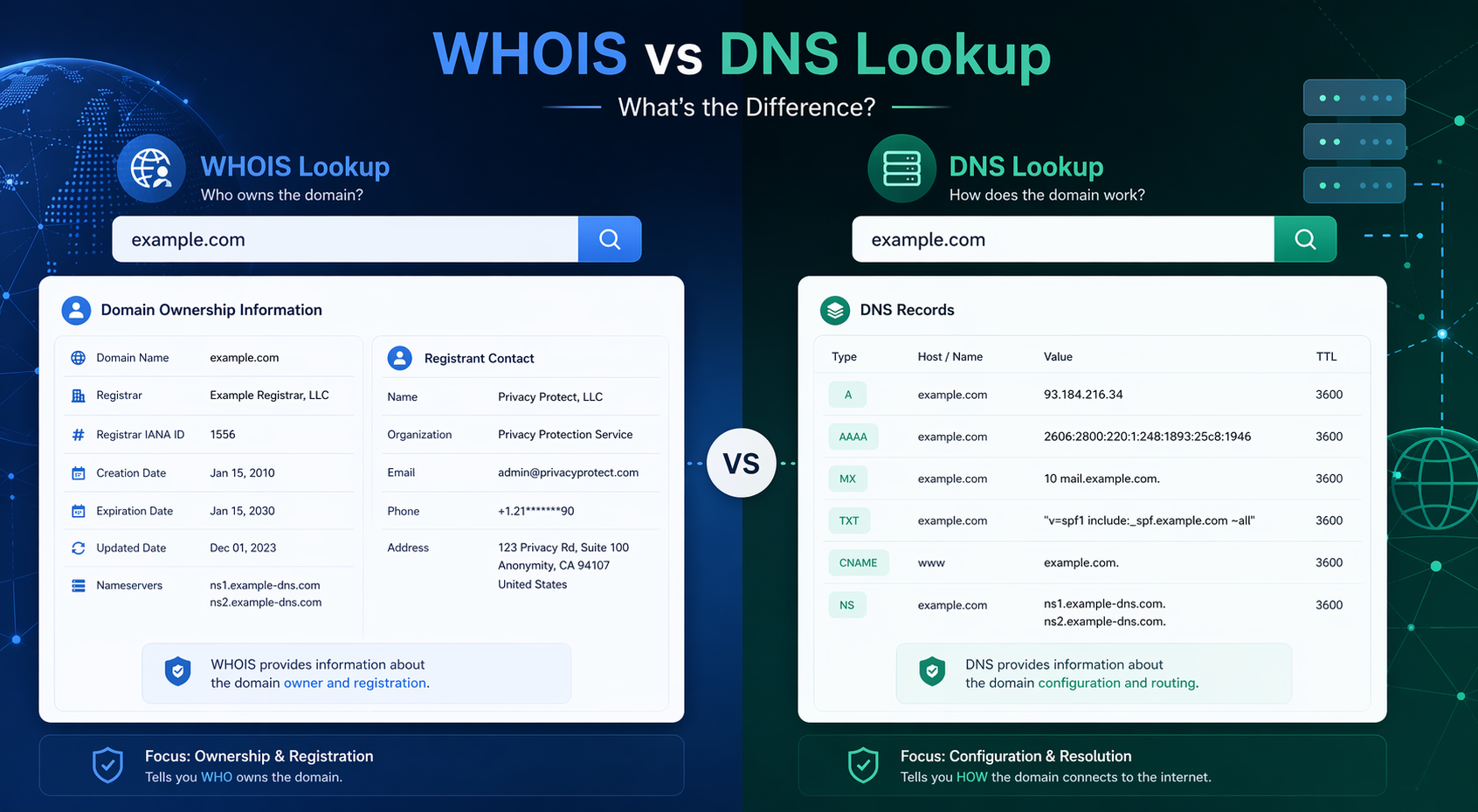
WHOIS vs DNS Lookup: Quick Explanation
WHOIS lookup and DNS lookup are often confused, but they answer two very different questions.
- WHOIS lookup tells you who registered a domain and which registrar manages it
- DNS lookup tells you how that domain is configured to route traffic on the internet
In short: WHOIS is about ownership and registration, while DNS is about technical configuration.
What Is a WHOIS Lookup?
A WHOIS lookup retrieves public domain registration data. It is commonly used to investigate who registered a domain, when it was created, when it expires, and which registrar is responsible for it.
Typical WHOIS data may include:
- Registrar name
- Creation date
- Expiration date
- Domain status
- Name servers
- Registrant details, if not hidden by privacy protection
This makes WHOIS especially useful for domain research, cybersecurity investigations, brand protection, and ownership verification.
🔎 Free WHOIS Lookup Tool
Check domain ownership, registrar details, and registration dates instantly:
Run WHOIS Lookup →What Is a DNS Lookup?
A DNS lookup retrieves the technical records associated with a domain name. It helps determine where the domain points and how internet services such as websites and email are routed.
Common DNS records include:
- A record for IPv4 addresses
- AAAA record for IPv6 addresses
- MX record for mail servers
- TXT record for verification and email security
- CNAME record for aliases
DNS is essential for troubleshooting websites, mail delivery issues, and server configuration problems. Unlike WHOIS, it does not primarily tell you who owns a domain.
Key Differences Between WHOIS and DNS Lookup
| Feature | WHOIS | DNS |
|---|---|---|
| Main purpose | Ownership and registration | Routing and technical configuration |
| Typical data | Registrar, dates, status, nameservers | IP records, mail records, aliases |
| Best use case | Find domain owner or registrar | Check where a domain points |
| Useful for investigations | Yes | Yes, but more technical |
When Should You Use WHOIS?
Use WHOIS lookup when you want to understand the registration side of a domain. Typical use cases include:
- Finding the registrar of a domain
- Checking creation and expiration dates
- Investigating suspicious websites
- Researching ownership information
- Analyzing domain history and legitimacy
When Should You Use DNS Lookup?
DNS lookup is more useful when you are debugging technical issues or analyzing infrastructure. For example:
- Checking which IP address a domain resolves to
- Troubleshooting email delivery problems
- Inspecting mail records or verification records
- Understanding hosting or routing issues
Real-World Example
Imagine you find a suspicious website.
A WHOIS lookup can show when the domain was registered, which registrar it uses, and whether registration details are public or hidden.
A DNS lookup can reveal where the domain points technically, such as the server IP or mail configuration.
Both are useful, but if your first question is “Who registered this domain?” then WHOIS is the right place to start.
Why WHOIS Still Matters
Even though some WHOIS fields are now hidden because of privacy rules like GDPR, WHOIS remains one of the most useful public sources for domain investigation. It gives immediate visibility into registration dates, registrar details, nameservers, and domain status.
For security teams, developers, journalists, and domain buyers, it remains a core part of internet research.
FAQ
Is WHOIS the same as DNS?
No. WHOIS provides domain registration and ownership-related information, while DNS provides technical records that determine how the domain works on the internet.
Can WHOIS show the IP address of a domain?
Not directly. WHOIS is focused on registration data, not on the live DNS resolution of a domain.
Which one should I use first?
If you want to know who registered a domain, start with WHOIS. If you want to troubleshoot hosting, email, or routing, use DNS lookup tools.
Can WHOIS data be hidden?
Yes. Many registrars now hide personal details behind privacy protection services or GDPR-related redaction.
Start with a WHOIS Lookup
If you want to check domain ownership, registration dates, registrar information, or investigate a suspicious website, WHOIS is often the fastest first step.