How to Identify Datacenter IPs: A Practical Guide for Developers and Security Teams

How to identify datacenter IPs

Why Identifying Datacenter IPs Matters

Not all traffic comes from real users on residential or mobile networks. A significant share of automated traffic, scraping activity, fake account creation, credential stuffing, and abusive signups originates from hosting providers and cloud infrastructure.

That is why one of the most useful signals in modern web security is simple: is this IP address coming from a datacenter?

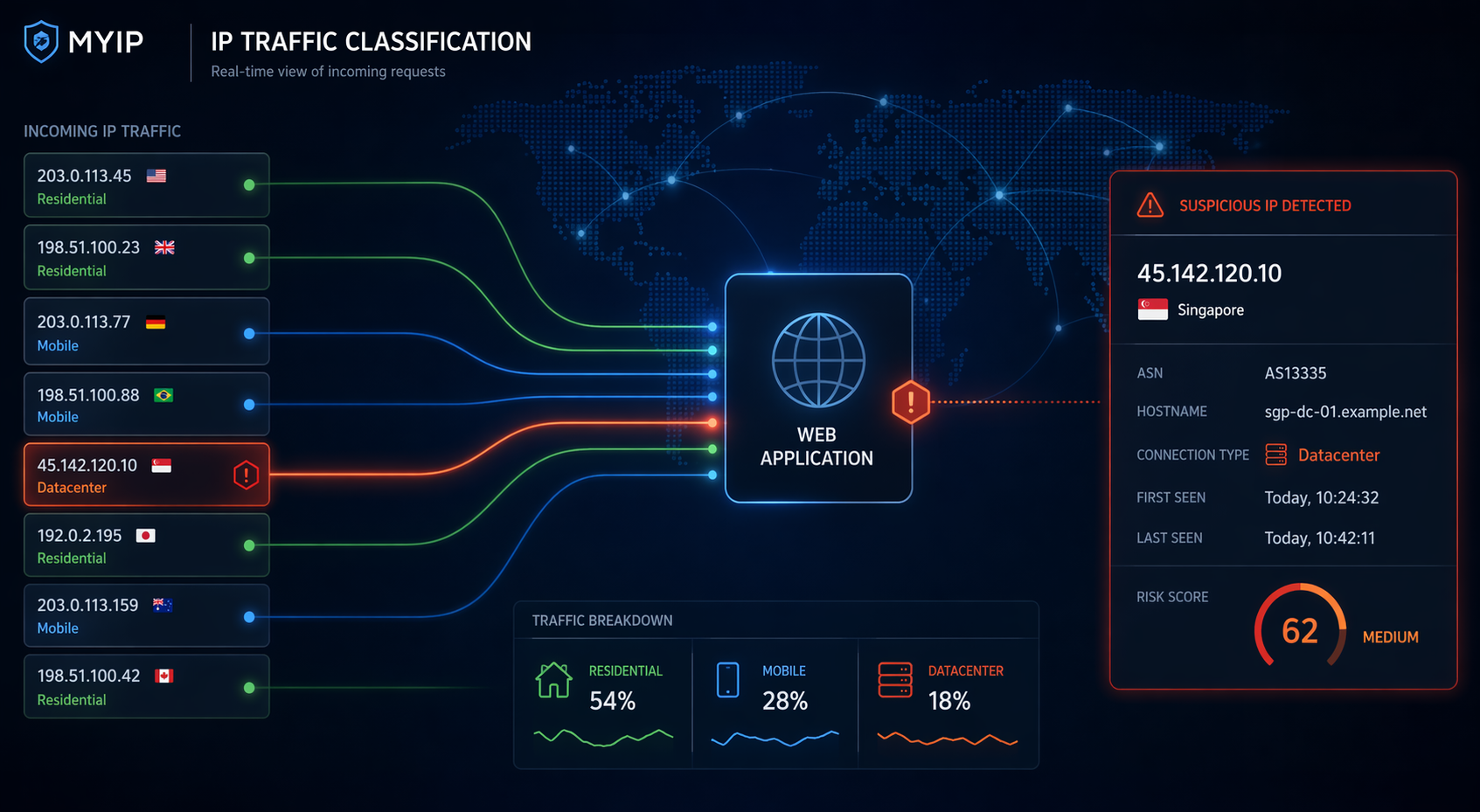
If you can classify an IP as residential, mobile, or datacenter, you immediately gain context. That context helps you decide whether to trust a request, challenge it, rate-limit it, log it more aggressively, or block it entirely.

What Is a Datacenter IP?

A datacenter IP is an IP address allocated to a hosting provider, cloud platform, VPS service, dedicated server, or other non-consumer infrastructure. These IPs are commonly associated with providers such as cloud networks, hosting companies, and server farms rather than home internet connections or mobile carriers.

Datacenter IPs are not inherently malicious. Many legitimate services use them every second of the day. Search engine crawlers, uptime monitors, API integrations, CI/CD systems, and enterprise infrastructure all rely on hosted IP space.

The problem is that attackers use the same infrastructure because it is cheap, scalable, and easy to rotate.

Why Attackers Prefer Datacenter IPs

Datacenter IPs are attractive for abuse because they offer speed, automation, and scale. A bad actor can deploy scripts from a virtual machine, spin up new servers quickly, and distribute requests across multiple IP ranges. Compared with residential traffic, hosted infrastructure is much easier to weaponize.

This makes datacenter IP detection useful in situations such as:

  • Blocking large-scale scraping and crawling
  • Reducing fake signups and disposable account creation
  • Limiting brute-force or credential stuffing attacks
  • Protecting referral programs and promo offers
  • Scoring traffic quality for analytics and fraud review

How to Identify Datacenter IPs

There is no single perfect indicator. Reliable detection usually combines multiple network signals into one classification layer.

1. ASN and Network Ownership

One of the strongest signals is the ASN, or Autonomous System Number, associated with an IP address. If the ASN belongs to a known cloud provider, VPS company, or hosting network, that is a strong sign the IP is not residential.

For example, if an IP belongs to an infrastructure-heavy organization rather than an ISP serving households, it is often categorized as hosting or datacenter traffic.

2. Network Type Classification

A strong IP intelligence system should not stop at geolocation. It should classify the network into categories such as:

  • Residential
  • Mobile
  • Datacenter
  • Proxy
  • Tor
  • VPN

This classification is more useful than city-level location alone because it tells you how the IP is being used, not just where it appears to be located.

3. Reverse DNS and Hostname Patterns

Reverse DNS can sometimes reveal that an IP belongs to a hosting provider. Hostnames may contain clues related to virtual machines, cloud regions, server nodes, or provider branding. While reverse DNS is not sufficient on its own, it can reinforce other signals.

4. Known Hosting Ranges

Many IP intelligence systems maintain internal knowledge of cloud and hosting allocations. If an IP falls into a range commonly associated with server infrastructure, it can be flagged as a likely datacenter IP. This is one of the core building blocks of practical classification.

5. Behavioral Context

An IP becomes even more suspicious when datacenter classification is combined with abusive behavior: high request volume, repeated account creation, rapid login attempts, impossible browsing patterns, or automation signatures. In real systems, network type and behavior work best together.

Why Geolocation Alone Is Not Enough

Many teams start with a basic geolocation database and assume it will help them filter suspicious traffic. It helps a little, but not enough. A datacenter IP can still resolve to a perfectly valid city, region, and country. Geographically, it looks normal. Operationally, it may be part of a server farm running automated traffic.

This is why the question is not just Where is this IP located? but also What kind of network is this IP coming from?

Common Mistakes When Checking for Datacenter IPs

Many implementations fail because they rely on one weak signal instead of combining several. Here are common mistakes:

  • Assuming every non-residential IP is malicious
  • Blocking entire cloud providers without any review logic
  • Using static IP lists without updating classification
  • Relying only on WHOIS or reverse DNS lookups
  • Ignoring IPv6 ranges and focusing only on IPv4

The goal is not blind blocking. The goal is better context and better decision-making.

Practical Use Cases for Datacenter IP Detection

Signup Protection

If you run a SaaS product, free trial platform, forum, or marketplace, datacenter IPs can be used as part of your anti-abuse flow. A signup from a hosted IP does not automatically mean fraud, but it may justify extra verification, rate-limiting, or temporary restrictions.

Login Risk Analysis

When a login request comes from a datacenter IP instead of the user’s usual residential network, that can raise a risk flag. Combined with device mismatches or unusual geography, this becomes a powerful authentication signal.

Scraper and Bot Mitigation

Many scraping systems operate from server infrastructure. Detecting datacenter IPs can help distinguish legitimate visitors from scripted traffic harvesting content, pricing, product catalogs, or search results.

Ad and Referral Abuse

Promotional systems are often targeted by bots running from cloud infrastructure. Identifying hosted IPs can reduce fake clicks, self-referrals, coupon abuse, and reward farming.

What a Good Datacenter IP API Should Return

If you are integrating this into production, you need more than a yes-or-no answer. A useful API should provide structured context such as:

  • IP address
  • ASN and network organization
  • Connection type or usage classification
  • Hostname if available
  • Datacenter flag
  • VPN / proxy / Tor indicators
  • Risk score or confidence signal

This allows you to build rules that are precise instead of overly aggressive.

Example: Checking Whether an IP Is a Datacenter IP

In practice, the cleanest approach is to query an IP intelligence API and enrich the incoming request before applying your business logic.

curl -H "X-API-Key: YOUR_KEY" https://myip.casa/api/pro/security?ip=203.0.113.25

A typical response should tell you whether the IP appears to come from datacenter infrastructure, alongside other useful security attributes.

{
  "ip": "203.0.113.25",
  "network": {
    "asn_org": "Example Hosting Provider",
    "connection_type": "datacenter",
    "hostname": "server-25.example.net"
  },
  "security": {
    "is_datacenter": true,
    "is_proxy": false,
    "is_tor": false,
    "is_vpn": false,
    "risk_level": "Medium"
  }
}

From there, your application can decide whether to allow the request, rate-limit it, require additional verification, or log it for review.

Datacenter IP Detection and False Positives

One important nuance: some legitimate users browse from hosted environments. Security researchers, privacy-conscious users, corporate gateways, uptime systems, and API clients may all appear from cloud infrastructure.

That is why datacenter detection should usually be a risk signal, not a sole source of truth. In many cases, the best approach is to combine it with other checks such as request frequency, account age, device reputation, and user behavior.

πŸ› οΈ Datacenter IP Detection Checklist

If you want a reliable way to identify datacenter IPs, your stack should include:

  • βœ… ASN lookup and network ownership
  • βœ… Connection type classification
  • βœ… Datacenter / VPN / proxy / Tor flags
  • βœ… IPv4 and IPv6 support
  • βœ… JSON API responses for automation
  • βœ… Behavior-aware risk scoring when possible
  • βœ… Low-friction integration with simple auth
Explore Our Free Tools β†’
"The most useful question in traffic analysis is often not where an IP is located, but what kind of network it comes from."

Final Thoughts

Datacenter IP detection is one of the easiest ways to improve abuse prevention without adding too much friction for real users. It gives you a fast signal that helps separate likely automation from normal consumer traffic.

For developers and security teams, this is not about blocking the internet. It is about adding context to every request so your decisions become smarter, faster, and more consistent.

If you want to identify datacenter IPs in your application, the best approach is to combine ASN intelligence, network classification, and security flags through a lightweight API that works immediately.

β†’ Get Your API Key β†’ View Developer Documentation β†’ Test an IP with Our Tools